What happens after rehab?
After rehab, treatment usually steps down rather than stops: most people move to less intensive outpatient care, settle where they will live, build support around them and plan for the higher-risk first months.
Reviewed against public records, October 2026 · Sources at the end of this page
Does treatment end when rehab ends?
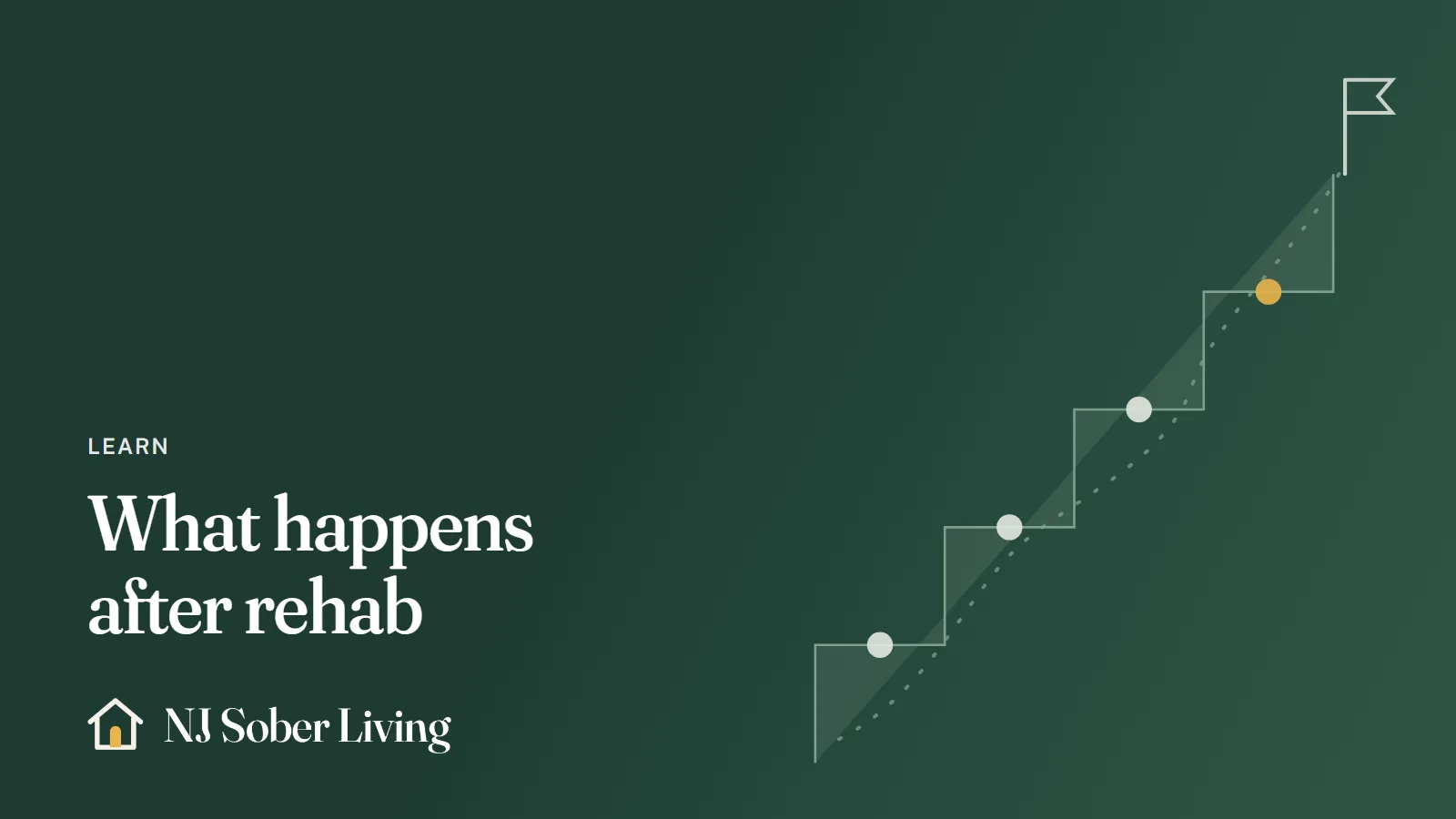
No. Recovery usually continues in less intensive care. NIDA's research guide says that for many patients, a continuing care approach gives the best results, with treatment intensity changing as their needs change.
Residential or inpatient
You live at the program, with treatment and support through most of the day.
Most hoursPartial hospitalization
Treatment for most of the day on weekdays, while you sleep at home or in a sober living home. Some programs call it day treatment.
Intensive outpatient
Several sessions a week, often in the evening, so days can go to work or school.
Outpatient and recovery support
Regular sessions on a lighter schedule, alongside support groups and the people around you.
Fewest hours
Not everyone takes every step, and the order can change. Under the ASAM Criteria, patients are reassessed regularly and move to more or less intensive care as their needs change.
Detox is only the first stage of addiction treatment, NIDA notes, and research indicates most people need at least 3 months in treatment, with the best outcomes from longer care.
In NJ Sober Living's homes
Residents in outpatient treatment attend an outside licensed program on the schedule it sets, and the house van drives them to evening sessions and back. The house is a Class F licensed home, not treatment.
Where do people live after rehab?
Most people go home, move into a sober living home, or find a new place of their own; the right choice depends on how safe and substance-free that home is.
SAMHSA counts home, "a stable and safe place to live," as one of four dimensions of recovery. The choice is yours, made with your treatment team. Here is what each option offers.
At a glance
After rehab, in three numbers
- 3 monthsThe minimum time in treatment most people need, NIDA notes; the best outcomes come from longer care.
- 40–60%Relapse rates for substance use disorders, similar to hypertension at 50–70% (NIDA).
- 18 monthsHow long a study followed 300 residents of two California sober living programs (Polcin et al., 2010).
Sources: NIDA; Polcin et al., 2010. Details and links at the end of this page.
What does a week look like after rehab?
A steady week usually holds treatment sessions, work or school, support meetings, chores and rest at predictable times.
SAMHSA names purpose, meaningful daily activity such as a job or school, as another dimension of recovery.
A week in NJ Sober Living's homes
Mornings
Up on the house schedule, the shared kitchen, then out to work, school or a daytime commitment.
Days
Belong to the resident, within house expectations: a job, errands, exercise, a recovery meeting.
Evenings
Treatment nightsOutpatient treatment on the schedule your program sets. The house drives residents there and back.
Other eveningsAt home with housemates, under curfew, with an operator in the house overnight.
- A live-in operator and an operator on site 7 p.m.–7 a.m., plus house management and behavioral health technicians
- Periodic drug testing
- House expectations confirmed before move-in
What support helps after rehab?
Mutual-help groups, people in recovery and family support carry on after formal treatment. NIDA notes that self-help groups can complement and extend the effects of professional treatment.
12-step fellowships: AA and NA
Alcoholics Anonymous and Narcotics Anonymous are peer fellowships built on the 12 steps, with no dues or fees. Most treatment programs encourage self-help groups during and after formal treatment, NIDA notes, and in the California sober living study, 12-step involvement was a strong predictor of how residents did.
Official meeting finders
- Alcoholics Anonymous aa.org
- Northern New Jersey AA nnjaa.org
- Narcotics Anonymous of New Jersey nanj.org
How 12-step programs work · Meeting times and places change; use each fellowship's own finder.
SMART Recovery
SMART Recovery is a free, evidence-informed mutual-support program that focuses on self-empowerment and practical skills rather than the 12 steps. Meetings run in person and online, and it also has groups for family and friends.
Official meeting finder
Meeting times and places change; use the program's own finder.
Al-Anon, for families and friends
Al-Anon is for people worried about someone else's drinking: parents, partners, adult children and friends. Members share their own experience, and the person in recovery doesn't need to attend.
Official meeting finders
Meeting times and places change; use each group's own finder.
Your treatment team and peers
The counselor, prescriber and program staff who already know your plan are support too. Before discharge, ask how to reach them between sessions and what to do if a week goes badly.
Peers from treatment who are also staying sober know what the first months feel like. Swap numbers before you leave, and keep them saved next to your crisis lines.
Why are the first months after rehab a higher-risk time?
Because relapse is common and tolerance drops: NIDA puts relapse rates for substance use disorders at 40–60%, similar to hypertension at 50–70%, and after time without using, a former amount can cause an overdose.
That is because the body is no longer adapted to its earlier level of use. Relapse doesn't mean treatment has failed; NIDA treats it as a sign to resume, change or try new treatment. What to do after a relapse
Who to call
- Overdose or emergency911
- 988 Suicide & Crisis Lifeline · call or text, 24/7988
- SAMHSA National Helpline · free, confidential, 24/7 treatment referrals1-800-662-4357
- ReachNJ · New Jersey's addiction helpline, 24/71-844-732-2465
SAMHSA's helpline offers referrals and information, not counseling. TTY 1-800-487-4889.
What should your aftercare plan cover before you leave rehab?
Before discharge, know your next appointment, where you will live, who you will call and what you will do if you use again.
Your first continuing-care appointment, booked
A date, a time and a place, set before you leave rather than after.
Where you will live, and its rules
If it's a recovery residence, read the house rules and know your move-in date before discharge.
A medication plan with the prescriber who will continue it
Who prescribes after discharge, and how refills work until your first appointment with them.
The groups or meetings you will try
Pick a first meeting or group from the fellowship's own finder, and know how you'll get there.
People to call, with numbers saved
Your counselor, a peer or sponsor, family, and 988, SAMHSA and ReachNJ saved in your phone.
What you will do after a slip
Who you will tell, and how quickly you will get back in touch with your treatment team.
Questions people ask about life after rehab
Short answers on length of stay, work, medication, families and readiness. Each one comes from the sources at the end of this page or from how NJ Sober Living's homes work.
There is no fixed length. NIDA's research guide says most people need at least 3 months in treatment to significantly reduce or stop their drug use, and the best outcomes come with longer treatment. At NJ Sober Living, residents step toward living on their own as stability holds; ask about length on the call.
In NJ Sober Living's homes, yes. Residents must be working, in school or in treatment, or begin one of those within 30 days of moving in. Residents in outpatient treatment keep the schedule their outside program sets, with the house driving them to evening sessions and back.
It depends on each home's policy, so ask before you move in. NJ Sober Living's homes suit people taking MAT medications under outside psychiatric care.
Al-Anon holds meetings for relatives and friends worried about someone's drinking, in New Jersey and online. Ask the treatment team whether family sessions are part of the discharge plan, and agree together on what support will look like after the move.
Say so to your treatment team before discharge. Under the ASAM Criteria, patients are reassessed regularly, and the plan can move to more or less intensive care as needs change.
Four recovery homes in Bergen County, Class F licensed by NJ DCA, with rides to evening treatment.
Sources
- National Institute on Drug Abuse. Drugs, Brains, and Behavior: The Science of Addiction, "Treatment and Recovery".
- National Institute on Drug Abuse. Principles of Drug Addiction Treatment: A Research-Based Guide, 3rd ed. (2014): principles 5, 8 and 10; "Where do 12-step or self-help programs fit".
- American Society of Addiction Medicine. About the ASAM Criteria (4th ed., 2023).
- SAMHSA. About Recovery: health, home, purpose, community.
- SAMHSA. National Helpline, 1-800-662-HELP (4357).
- New Jersey Department of Human Services. ReachNJ, 1-844-REACHNJ (732-2465).
- 988 Suicide & Crisis Lifeline.
- Polcin DL, Korcha R, Bond J, Galloway G (2010). What did we learn from our study on sober living houses and where do we go from here? Journal of Psychoactive Drugs 42(4):425–433.