What is a sober living home?
A sober living home is a shared, alcohol- and drug-free house where people in recovery live together under house rules while they work, attend outpatient treatment and rebuild daily life. It is a home, not a treatment program.
- Not treatment
- No on-site counseling, therapy or clinical care under New Jersey's rule; support stays non-clinical.
- Regulated in NJ
- The state licenses cooperative sober living residences under a Class F license.
- 10 residents at most
- Under the state rule, not counting the operators.
Reviewed against public records, October 2026: NJ Department of Community Affairs; N.J.A.C. 5:27, effective January 6, 2025. Sources
What does a sober living home provide, and what does it leave to treatment?
A sober living home provides a substance-free place to live, written house rules and people who hold residents to them; it does not provide therapy, medical care or prescriptions.
In NJ Sober Living's homes
- All four are Class F licensed by NJ DCA, with a live-in operator, an operator on site 7 p.m.–7 a.m., and house management and behavioral health technicians.
- Curfew, periodic drug testing and house expectations hold the structure.
- Each home confirms its rules with a resident before move-in.
- Residents attend a licensed outpatient program nearby in the evening, and the house drives them there and back.
What the house provides
Six things make a house a sober living home:
- A substance-free homeNo alcohol or drugs in the house, for anyone.
- Written house rulesThe rules the house runs by, in writing.
- Someone who enforces themAn operator or house manager; in peer-run homes, the residents themselves.
- Drug and alcohol testingNew Jersey lets house rules require it weekly.
- A curfewReasonable, and never during work or recovery activities.
- Housemates in recoveryPeers who hold each other to the same goal.
What it leaves to treatment providers
Four things happen outside the house:
- Therapy and counselingNew Jersey's rule bars on-site counseling and therapy.
- Medical and psychiatric careFrom a doctor or psychiatrist, not the house.
- Prescribing medicationThe house can store it safely; it never prescribes it.
- Clinical assessmentDone by the outpatient or treatment provider.
Sources: N.J.A.C. 5:27-2.1 and 5:27-13.2; NARR Standard 3.0.
Are all sober living homes the same? The four levels of support
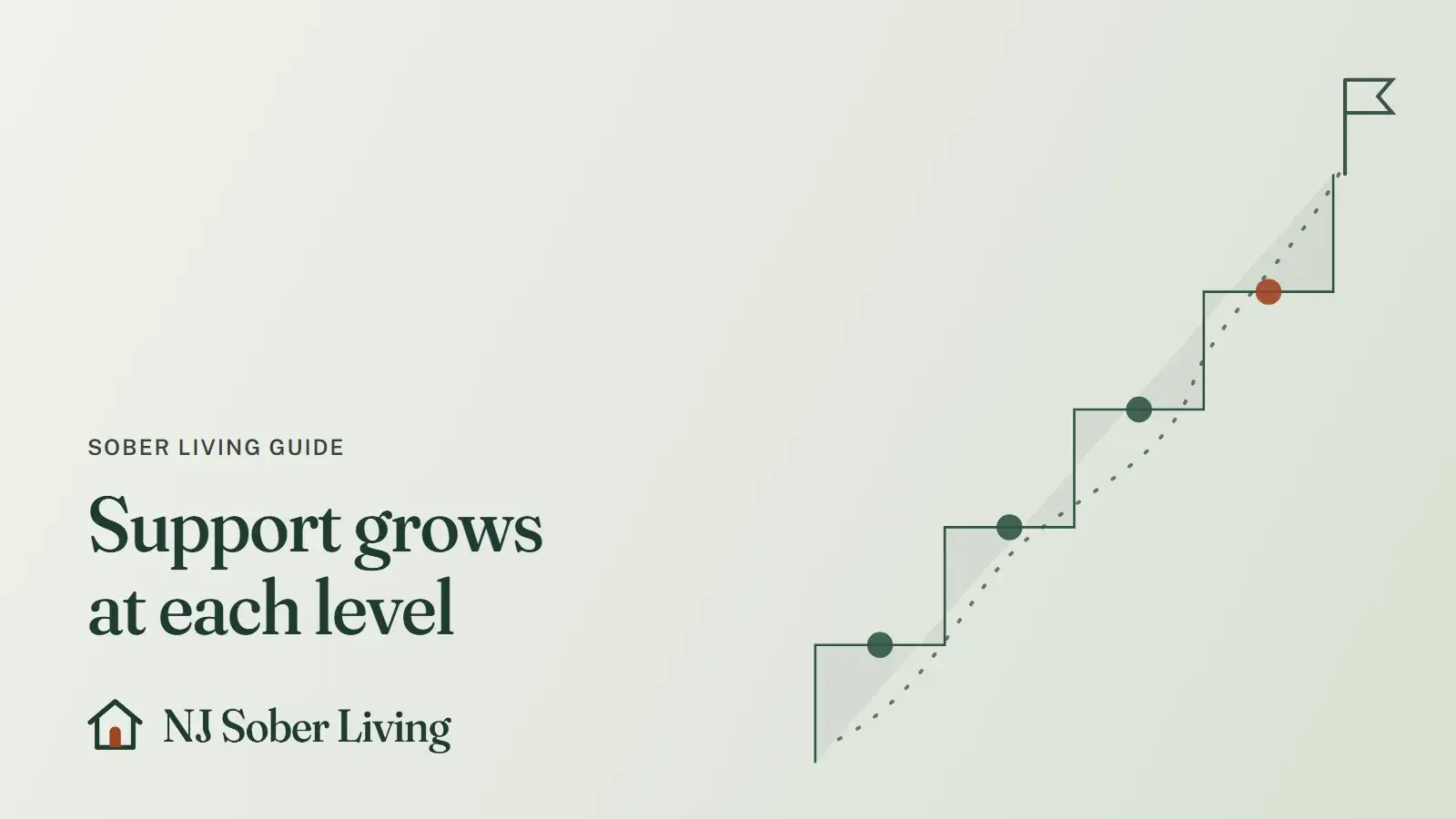
No. The National Alliance for Recovery Residences (NARR) sorts recovery homes into four levels, from peer-run to clinical. Support grows at each level.
Peer-run
Level IDemocratically governed by the residents themselves. Oxford Houses are the best-known example.
Monitored
Level IIA senior resident or house manager runs the house day to day, with house rules and structure.
Supervised
Level IIITrained or credentialed staff, for residents who need more support than Levels I and II give.
Clinical
Level IVSupervised peer and professional staff, with clinical services alongside the housing.
NARR's levels describe support, not a state license. Sober living homes are also called recovery residences, sober homes or recovery homes; a halfway house is something else: sober living vs. halfway house. Sources: NARR Standard 3.0 (2018) and NARR's recovery residence levels; Jason et al. (2006) on Oxford House.
How does New Jersey regulate sober living homes?
New Jersey licenses cooperative sober living residences under a Class F license from the Department of Community Affairs (N.J.A.C. 5:27).
N.J.A.C. 5:27, Class F · as amended, effective January 6, 2025
The state rule sets eight requirements a resident will notice:
- 10 residents at mostNot counting the operators.
- Two operators, one there overnightOne on site from 7:00 p.m. to 7:00 a.m. when residents are present, and at least one living in the residence.
- Weekly testing allowedHouse rules may require drug and alcohol tests of every resident each week.
- A reasonable curfewIt doesn't apply during work or recovery activities, or block visits and errands.
- Medication lockboxesThe home provides them so residents can secure prescriptions.
- No keyed bedroom locksBedroom doors can't have keyed entry locks or deadbolts.
- Serious incidents reportedA death, overdose or assault that brings first responders is reported to the Department.
- Non-clinical support onlyNo on-site counseling, therapy or clinical treatment.
This describes the state rule, as general information, not legal advice. Ask any home whether it holds a Class F license.
Who is sober living for?
A recovery residence fits people who have finished, or are stepping down from, a higher level of treatment and need a stable home before living on their own.
Stepping down from treatment
Leaving residential care or intensive outpatient, and not ready to live alone yet.
Working through recovery
People who need their days free for a job, with treatment in the evening.
Taking prescribed medication, including MAT
Substance-free doesn't rule out medication taken as prescribed, including for opioid use disorder.
After a relapse
People with earlier relapses who want daily accountability around them this time.
When home, rides or routine are the barrier
For people whose obstacle is housing, transportation or day-to-day structure, more than treatment itself.
Does sober living work? What the research shows
Two studies that followed residents for 18 and 24 months found more abstinence than at entry, and less substance use than usual care.
300 people entering two California sober living programs, interviewed at entry and at 6, 12 and 18 months.
| Program | Entry | 6 mo | 12 mo | 18 mo | Avg. stay |
|---|---|---|---|---|---|
| Options Recovery Services, Berkeley | 11% | 68% | 68% | 46% | 254 days |
| Clean and Sober Transitional Living, Sacramento County | 20% | 40% | 45% | 42% | 166 days |
Polcin, Korcha, Bond and Galloway (2010), Journal of Psychoactive Drugs 42(4):425–433. Entry measures the 6 months before moving in. Both studies are outside New Jersey.
150 adults in Illinois, randomly assigned after inpatient treatment to an Oxford House or usual care (outpatient treatment or self-help groups), followed for 24 months.
| Measure | Oxford House | Usual care |
|---|---|---|
| Substance use | 31.3% | 64.8% |
| Monthly income | $989 | $440 |
| Incarceration | 3% | 9% |
Jason, Olson, Ferrari and Lo Sasso (2006), American Journal of Public Health 96(10):1727–1729. Oxford Houses are peer-run (NARR Level I). Both studies are outside New Jersey.
How do you choose a sober living home in New Jersey?
Choose a sober home by asking the right questions before move-in, and by visiting the house.
Read the house rules first, then ask who is on site overnight, how testing and medication storage work, and what happens after a relapse. Our guide walks through every question, the red flags to watch for and a sheet for comparing homes side by side.
Before you move in
Five checks before you decide
- Read the house rulesStart with the written rules the home runs by.
- Ask who is on site overnightNew Jersey's rule puts one operator on site from 7:00 p.m. to 7:00 a.m. when residents are present.
- Ask how testing and medication storage workThe rule allows weekly testing and requires medication lockboxes.
- Ask what happens after a relapseUnder N.J.A.C. 5:27-3.3, a home can remove a resident for breaking its rules.
- Visit the houseSee it before you decide.
N.J.A.C. 5:27-2.1, 5:27-13.2, 5:27-13.3 and 5:27-3.3.
Questions people ask about sober living
There is no fixed length. In a study of 300 residents at two California sober living programs, average stays were 166 days at one and 254 days at the other (Polcin et al., 2010). Oxford Houses set no maximum stay, and the description of the Oxford House model in Jason et al. (2006) puts the average stay at a little more than a year. At NJ Sober Living, residents step toward living on their own as stability holds.
It depends on the home's written policy, but New Jersey's recovery housing plan, using SAMHSA's definition, says substance-free does not prohibit prescribed medications taken as directed, including FDA-approved medications for opioid use disorder. Class F homes must provide lockboxes for prescription medication. NJ Sober Living's homes are a fit for people taking MAT under outside psychiatric care.
Not everywhere. New Jersey's rule lets a home require or encourage residents to attend self-help programs or use off-site services. At NJ Sober Living, residents attend a licensed outpatient program nearby in the evening, and the house drives them there and back.
It can. Under N.J.A.C. 5:27-3.3, a resident of a cooperative sober living residence may be removed by the operator's determination or a vote of the residents, following the procedure in the house rules, for breaking those rules, including rules against using alcohol or drugs. Ask any home, ours included, how it handles a relapse before you move in.
Yes. Oxford Houses are democratic, mutual-help recovery homes governed by their residents without professional staff. NARR calls this kind of home Level I, peer-run. NJ Sober Living's homes are staffed instead: Class F licensed by the New Jersey Department of Community Affairs, with a live-in operator, an operator on site overnight, and house management and behavioral health technicians.
Rent is $185 to $240 a week, covering a furnished bed, utilities, Wi-Fi, laundry facilities and the house structure and support. We confirm your exact rate and any fees before move-in. Call (201) 231-1066 and ask about the home that fits.
Four recovery homes in Bergen County, Class F licensed by NJ DCA, with rides to evening treatment.
Sources
- New Jersey Department of Community Affairs, State of New Jersey Recovery Housing Program Action Plan (draft), Program Definitions: Recovery House (definition from SAMHSA). nj.gov
- N.J.A.C. 5:27-2.1 (cooperative sober living residences), 5:27-13.2 (house rules) and 5:27-13.3 (safety), amended and adopted at 57 N.J.R. 13(b), effective January 6, 2025. Cornell LII
- N.J.A.C. 5:27-3.3, eviction of residents of cooperative sober living residences. Cornell LII
- National Alliance for Recovery Residences, NARR Standard 3.0 (November 2018) and recovery residence levels. narronline.org
- Polcin DL, Korcha R, Bond J, Galloway G (2010). What did we learn from our study on sober living houses and where do we go from here? Journal of Psychoactive Drugs 42(4):425–433. PMC3057870
- Jason LA, Olson BD, Ferrari JR, Lo Sasso AT (2006). Communal housing settings enhance substance abuse recovery. American Journal of Public Health 96(10):1727–1729. PMC1586125
This guide describes recovery housing in general and New Jersey's rule as general information. It is not legal or medical advice.