Sober living guide
Drug testing in sober living: how New Jersey sober homes test residents
Most sober living homes, also called recovery residences, make drug and alcohol testing a house rule, usually with random urine or saliva screens. In New Jersey, the state's rules let house rules require weekly screening of every resident (N.J.A.C. 5:27-13.2), and a 2025 law requires licensed cooperative sober living residences to test at random (P.L.2025, c.60). A positive screen should be confirmed by a lab test before a home makes a major decision, such as asking someone to leave (ASAM, 2017).
- Why
- A substance-free house for everyone in it
- How
- Random screens, usually urine
- NJ rules
- Weekly screening may be required; random testing by law
- After a positive
- Confirm it, then the written house rules decide
Reviewed against public records, October 2026: N.J.A.C. 5:27, P.L.2025, c.60, ASAM's drug testing consensus, MedlinePlus and SAMHSA. General information, not legal or medical advice. Sources
Why do sober living homes drug test residents?
Sober homes test because the house only works if everyone in it stays substance-free. ASAM's drug testing consensus calls testing particularly important where abstinence is the shared norm, and names recovery residences as one of those settings (ASAM, 2017).
A substance-free house
The group's footing rests on each resident's sobriety, so one person's use affects everyone who lives there.
ASAM, 2017Support, not punishment
Testing is meant to support recovery, and it takes the job of checking off housemates and staff and gives it to the test.
ASAM, 2017Honesty both ways
A test works alongside what a resident says. When the two don't match, that is a reason for a conversation.
ASAM, 2017
What do New Jersey's rules say about drug testing in sober living?
New Jersey lets a sober home's house rules require weekly drug and alcohol screening of all residents (N.J.A.C. 5:27-13.2). Since October 1, 2025, state law also requires licensed cooperative sober living residences to forbid alcohol and illicit drugs and to test residents at random (P.L.2025, c.60).
General information about the state rules. All four NJ Sober Living homes are Class F cooperative sober living residences licensed by the New Jersey Department of Community Affairs (DCA).
At a glance
New Jersey's testing rules
- WeeklyHouse rules may require screening of all residents
- RandomLicensed residences test at random, since October 1, 2025
- Drug-freeHomes must forbid alcohol and illicit drugs in the residence
Sources: N.J.A.C. 5:27-13.2 (effective January 6, 2025); P.L.2025, c.60. General information, not legal advice.
What kinds of drug tests do recovery residences use?
Most use a quick urine screen: urine is the most common sample for drug testing (MedlinePlus, 2025). Saliva (oral fluid) swabs are also used for screening, and breath tests check for alcohol (ASAM, 2017; MedlinePlus, 2025).
A screen at the house is a presumptive test. It gives a result in minutes and flags a class of drug above a set cutoff, but it can be wrong: some medicines and foods can trigger a false positive (MedlinePlus, 2025). A definitive test, done in a lab, names the exact drug, which is why a positive screen is usually followed by one (ASAM, 2017; MedlinePlus, 2025).
Two kinds of test
A screen, then a confirmation
Screen (presumptive)
- A cup, strip or swab at the house
- Results in minutes
- Flags drug classes above a cutoff
- Can be wrong: some medicines and foods can trigger it
Confirmation (definitive)
- Sent to a lab
- Chromatography and mass spectrometry
- Names the exact drug
- Used when a result is disputed or a big decision follows
Sources: ASAM, 2017; MedlinePlus, 2025
How does a drug test usually work in a sober home?
Testing is usually random and unannounced. ASAM favors random over fixed schedules, because a set day lets people time their use around the test, and calls weekly random testing appropriate in a recovery residence (ASAM, 2017).
- Random days
- No set weekday, so a test can come on any day of the week.
- Observed or not
- Watching a urine sample being given prevents tampering, but it can be distressing, especially for people with a history of trauma, so homes may use other safeguards instead (ASAM, 2017). Ask how this home does it.
- Missed or refused tests
- Ask how the home treats a missed or refused test before you move in, and get the answer in writing.
Will prescribed medication or MAT show up on a sober living drug test?
It can, and a positive result for a medication your prescriber ordered is an expected result, not a relapse (ASAM, 2017). Tell the home, and the person collecting the test, about every prescription, over-the-counter medicine and supplement you take (MedlinePlus, 2025).
Some medicines and foods can also cause a false positive, and poppy seeds can show up as opiates (MedlinePlus, 2025). SAMHSA's recovery housing guidance says homes should put no barriers or restrictions on residents' use of prescribed medications for behavioral or physical health conditions (SAMHSA, 2023).
What happens after a positive drug test in sober living?
It depends on the home's written house rules, so read them before you move in. Some homes ask a resident to leave after a positive test, and ASAM notes that can happen in a recovery residence. It also says a result used for a decision that big should be confirmed by a lab test first (ASAM, 2017).
In a licensed New Jersey cooperative residence, a resident who breaks the house rules, including the rules against alcohol and drugs, can be removed by the procedure those rules set out (N.J.A.C. 5:27-3.3(c)). Wherever someone lives next, they should be able to keep seeing their outpatient treatment provider (ASAM, 2017).
After a positive screen
What a fair process looks like
- Talk it throughWhat you say about the result counts alongside the test.
- Confirm itA lab test if you dispute the screen or a big decision follows.
- The written rules decideThe home's own policy sets what happens next.
- Treatment continuesKeep seeing your outpatient provider, wherever you live.
Source: ASAM, 2017
What should you ask a sober living home about drug testing?
Ask for the testing policy in writing before you move in, and get answers to these eight questions. The same answers let you compare one home with another.
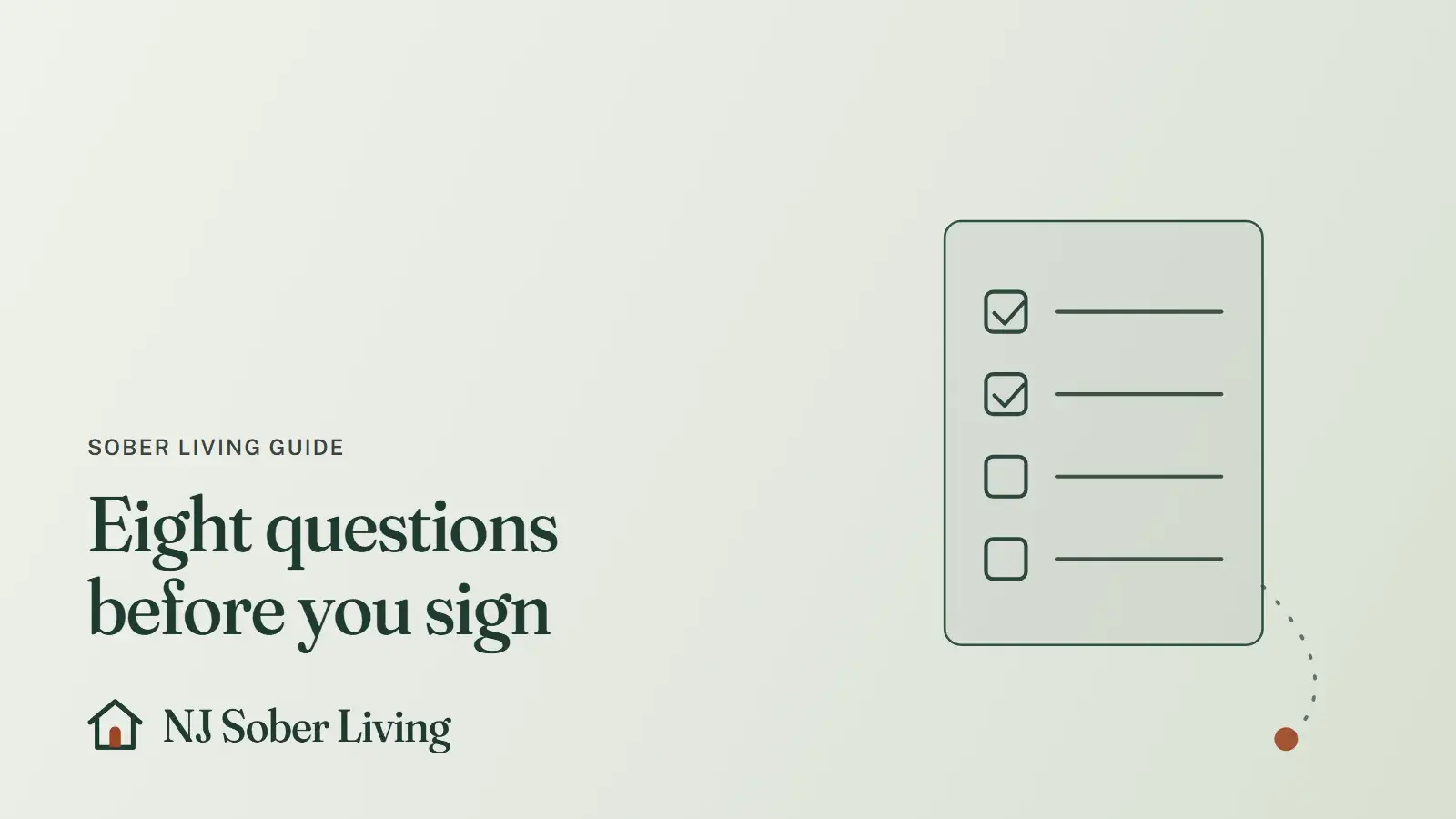
- How often do you test, and is it random?
- What kind of test, and who collects it?
- Is collection observed?
- Do you send a positive screen to a lab to confirm it?
- What happens after a positive, a missed or a refused test?
- Who sees my results, and are they shared with my treatment program or family?
- Who pays for the tests?
- How do you handle prescribed medication, including MAT?
Questions about drug testing in sober living
Short answers, each from the sources below.
Yes. Testing is usually a condition of living in the home, set out in the house rules you agree to before you move in. In New Jersey, house rules may require weekly screening of every resident (N.J.A.C. 5:27-13.2), and licensed cooperative sober living residences must test at random (P.L.2025, c.60).
Usually. A breath test measures the alcohol in your blood (MedlinePlus, 2025), and New Jersey's 2025 law requires licensed residences to forbid both alcohol and illicit drugs (P.L.2025, c.60).
Anywhere from hours to several days or more. It depends on the drug, how much was used, how long it was used and how the body processes it (MedlinePlus, 2025).
Yes. Some medicines and foods can cause a false positive, and poppy seeds can show up as opiates (MedlinePlus, 2025). If you dispute a screen, ask for a lab confirmation (ASAM, 2017).
No. A test only finds use inside its detection window, so a negative result shows what the test could see that day, not more (ASAM, 2017).
Each home sets its own policy. Ask whether tests are included in the rent or billed separately, and get the answer in writing.
Drug testing at NJ Sober Living
Periodic drug testing is part of living here.
All four homes are Class F licensed by NJ DCA, with a live-in operator, an operator on site overnight, and house management and behavioral health technicians, plus a curfew and one set of written house rules we go through with you before you move in. Ask us how testing works in the home that fits.
Sources for this guide
- American Society of Addiction Medicine (2017). The ASAM Appropriate Use of Drug Testing in Clinical Addiction Medicine, adopted April 5, 2017. Journal of Addiction Medicine, 11(3). asam.org
- National Library of Medicine, MedlinePlus (2025). Drug Testing, updated November 14, 2025. medlineplus.gov
- N.J.A.C. 5:27-13.2, additional rules for Class F cooperative sober living residences: house rules, as adopted at 57 N.J.R. 13(b), effective January 6, 2025. Cornell LII
- N.J.A.C. 5:27-3.3, removal of residents. Cornell LII
- New Jersey Legislature, P.L.2025, c.60 (Assembly No. 4535), approved June 3, 2025. pub.njleg.gov
- Substance Abuse and Mental Health Services Administration (2023). Best Practices for Recovery Housing, Publication No. PEP23-10-00-002. library.samhsa.gov
This guide describes New Jersey rules and public health guidance as general information. It is not legal or medical advice.